









Customer Churn

Customer Churn in ECommerce

Customer churn is one of the most pressing challenges in the e-commerce industry today, impacting profitability and growth. This article explores the factors leading to customer churn and leveraging insights to devise effective retention strategies. In this article I aim to share the key findings and offer practical recommendations for businesses to reduce churn and improve customer retention.

Customer Churn

Introduction

Customer churn refers to the rate at which customers stop doing business with a company over a certain period. In the highly competitive e-commerce landscape, customers can easily switch to a competitor’s platform for numerous reasons, such as better prices, preferred payment methods, or dissatisfaction with a product or service. Retaining existing customers is more cost-effective than acquiring new ones. Loyal customers contribute significantly to a business's revenue and growth. Data science offers powerful tools to predict churn and develop strategies for retention, leveraging vast amounts of customer data. By analyzing vast amounts of data generated by customer interactions, we can identify patterns and behaviors that indicate a risk of churn. Machine learning models can then be trained on this data to predict which customers are likely to churn and why.


“You can have data without information, but you cannot have information without data.” ~Daniel Keys Moran


Available Icon

Data Availability - Dataset with churn flag

Completeness Icon

Data Completeness - Missing Values

Quality Icon

Data Quality - Formatting Errors, Duplicate data

Integration Icon

Data Integration - CRM, Billing & Shipping, CS, and marketing data

Imbalanced Data Icon

Imbalanced Data - Class imbalance and bias in data

Historical Data Icon

Historical Data for Time Series Analysis

Privacy Icon

Privacy concerns and Compliance - GDPR, CNIL, CCPA

Cost Icon

Cost & Efforts - Resource Intensive, costly, Time-consuming, computational power

Competitive Disadvantages Icon

Competitive disadvantages

Challenges in Data Acquisition

Acquiring high-quality data for predicting customer churn involves several key challenges. Issues such as data with missing values, formatting errors & duplicates, complexity of integrating data from various sources such as CRM, billing, and marketing systems complicate the process. Limited historical data further hampers time series analysis, while class imbalance can bias predictive models. Ensuring compliance with privacy regulations (GDPR, CNIL, CCPA) is crucial to maintain customer trust and avoid legal issues. Additionally, data acquisition is resource-intensive, costly, and time-consuming, requiring substantial computational power.
Data Pre-Processing

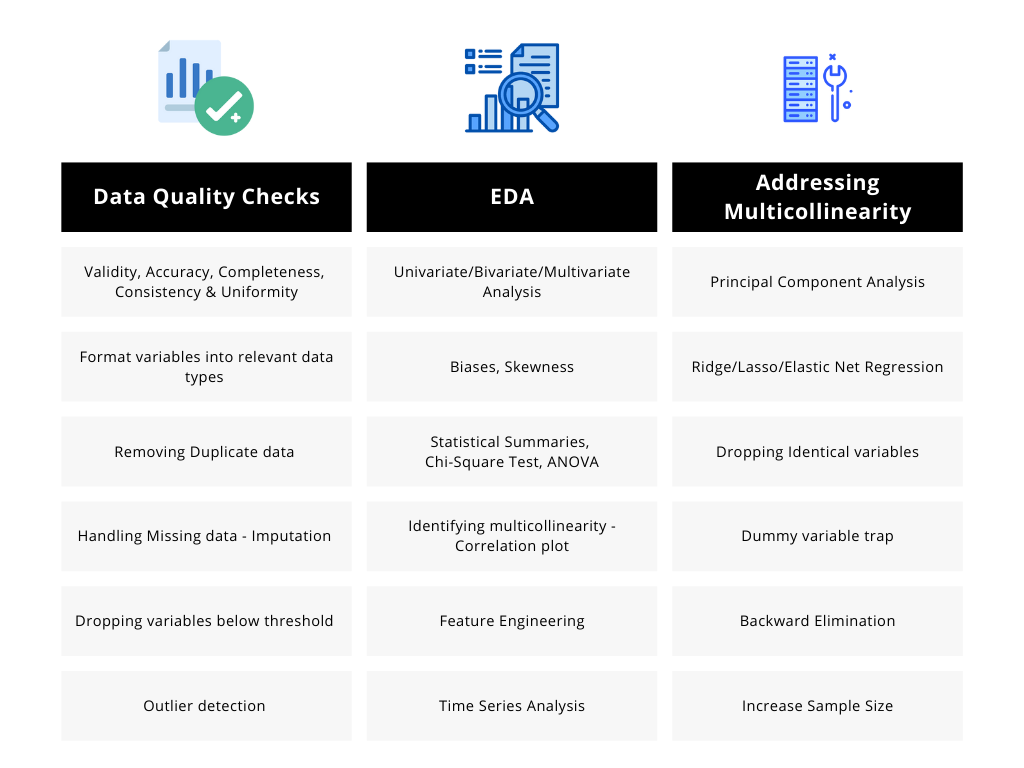
For any publicly obtained dataset, it is necessary to first explore the dataset and pre-process it. Having a clean dataset not only increase overall productivity but also allows us to derive highest quality insights which further helps in decision-making process. By focusing on Validity, Accuracy, Completeness, Consistency, and Uniformity we can ensure that the data is prepped for answering the business question on-hand and implementing machine learning algorithms.

Comprehensive data preprocessing offers several significant benefits. Firstly, it enhances model performance by ensuring that the data used to train machine learning models is clean and well-preprocessed, leading to more accurate and robust outcomes. Secondly, it provides reliable insights, as high-quality data ensures that the derived insights are both dependable and actionable, thereby supporting better business decisions. Additionally, preprocessing improves efficiency by reducing the time and effort required during the analysis phase, resulting in increased productivity. Lastly, it promotes scalability, as well-prepared data lays the groundwork for scalable and reproducible data science workflows, enabling more efficient analyses in the future.


“No data is clean, but most is useful.” ~ Dean Abbott


Addressing multicollinearity

Addressing multicollinearity is essential for creating reliable and interpretable statistical models and machine learning algorithms. Multicollinearity, where two or more predictor variables are highly correlated, can complicate the determination of individual predictor effects, leading to unstable and inconsistent coefficient estimates. This instability reduces model interpretability and can significantly diminish predictive performance by increasing the variance of coefficient estimates.

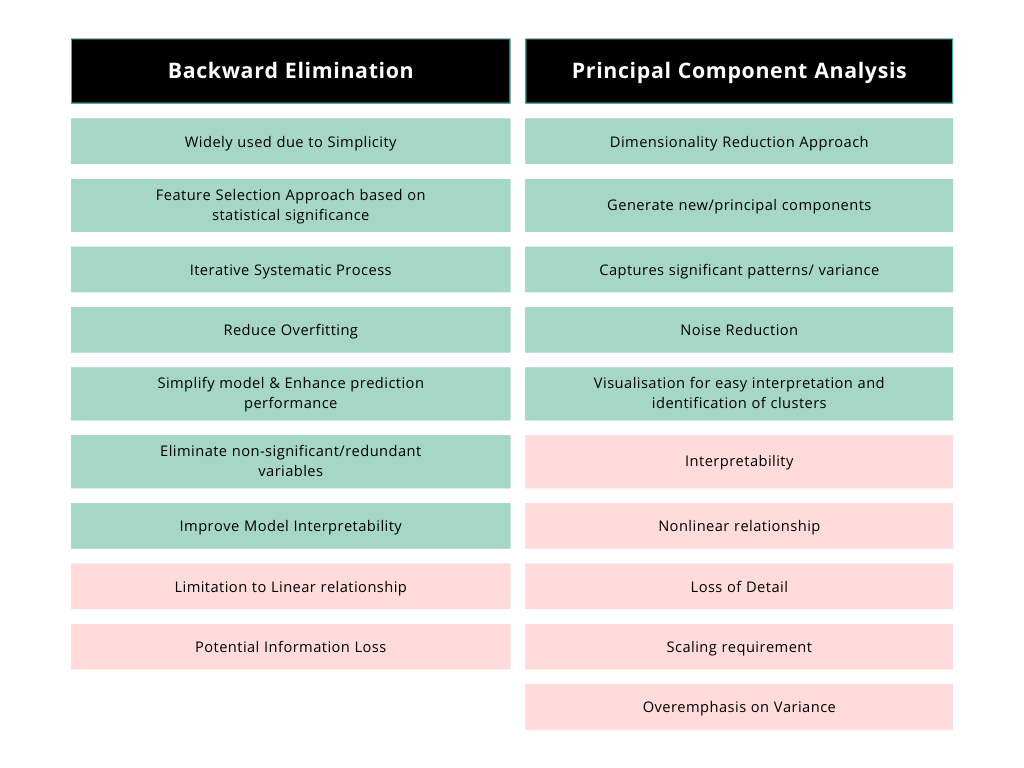
Furthermore, multicollinearity can hinder the efficiency of optimization algorithms used in model fitting, potentially causing overfitting and making the model capture noise rather than underlying patterns. To mitigate these issues, various techniques can be employed, such as Principal Component Analysis (PCA) to transform correlated variables into uncorrelated components. Addressing multicollinearity ultimately leads to more stable, efficient, and generalizable models.


Selecting the right Model/Classifier

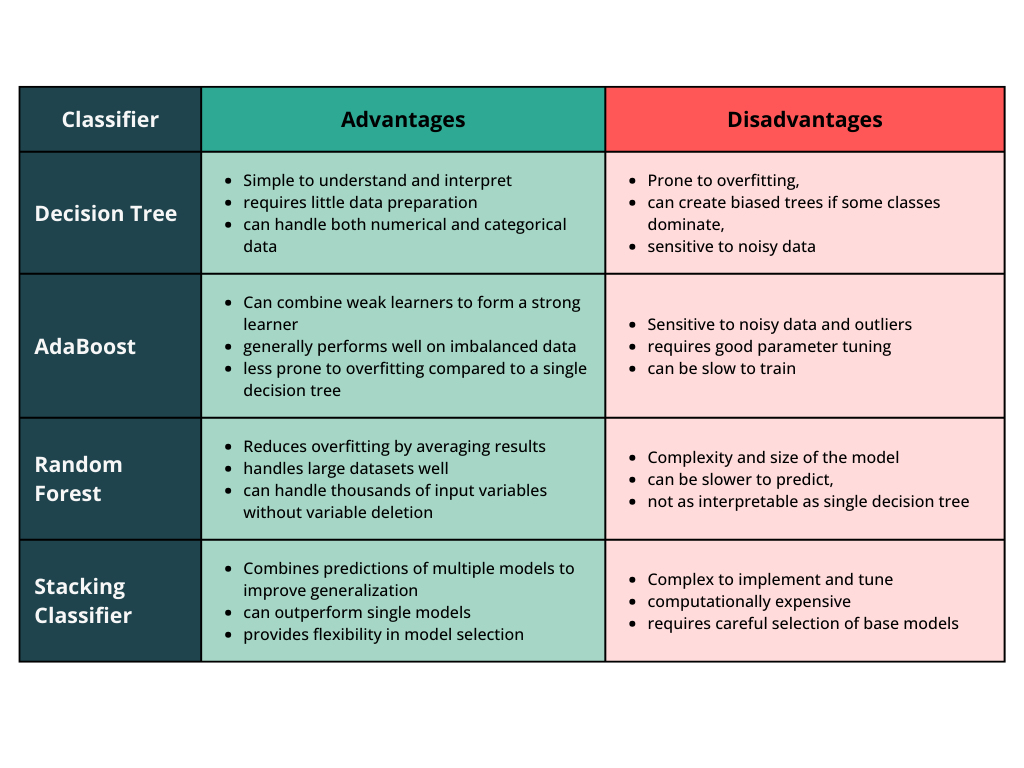
Selecting the right machine learning model for customer churn prediction is crucial for achieving accurate and actionable results. The first step is to understand the business context, identifying specific needs and priorities, such as whether minimizing false positives or maximizing true positives is more critical. Various models like logistic regression, decision trees, random forests, gradient boosting machines (GBM), support vector machines (SVM), and neural networks should be evaluated to determine which fits the data and business requirements best.

Considering the scalability and deployment of the model is essential. Chosen model should be capable of handling large data volumes and integrating seamlessly with existing systems for real-time prediction and monitoring. By following these steps, businesses can develop robust churn prediction models that enhance customer retention strategies and drive growth.


Customer Churn

Performance Evaluation Criteria

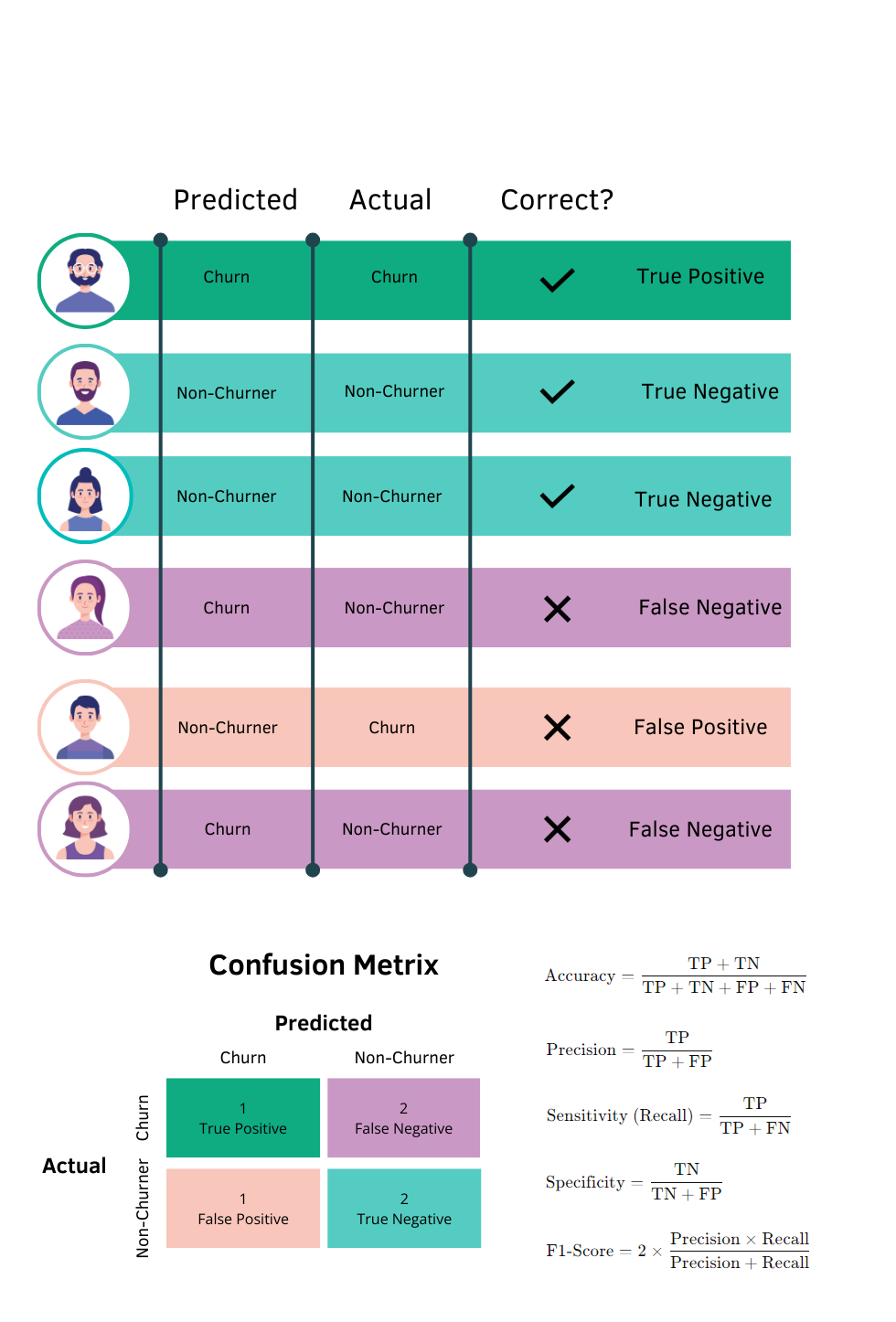
Choosing the right model and evaluating its performance is essential for making accurate predictions. Performance evaluation criteria help measure how well a model works, guiding the selection and improvement of models.


    Accuracy Score: Accuracy measures how often the model makes correct predictions. It’s a simple way to see if the model is generally right. This is particularly useful when the data has a balanced mix of classes, like churn and non-churn customers.


    Precision Score: Precision focuses on the accuracy of positive predictions. In churn prediction, it shows how many of the customers predicted to churn actually do churn. High precision is important when the cost of false alarms is high, like offering incentives to customers who wouldn’t have left anyway.


    Sensitivity Score (Recall): Sensitivity, or recall, measures how well the model identifies actual churners. A high sensitivity score means the model catches most of the customers who are likely to churn, which helps in reducing customer loss.


    Specificity Score: Specificity measures how well the model identifies non-churners. A high specificity score means the model correctly identifies customers who are not likely to churn, preventing unnecessary promotions and discounts based on incorrect predictions.


    F1-Score: The F1-score balances precision and sensitivity, providing an overall measure of the model’s accuracy. It’s useful when the data has a big difference in the number of churn and non-churn customers, ensuring that both false alarms and missed churns are minimized.


    ROC AUC Score: ROC AUC (Receiver Operating Characteristic Area Under the Curve) score tells us how well the model distinguishes between different outcomes, like churn and non-churn customers. A higher score means the model is better at telling these apart, which is important when the data has an uneven mix of outcomes.


Available Icon

Customer Segmentation

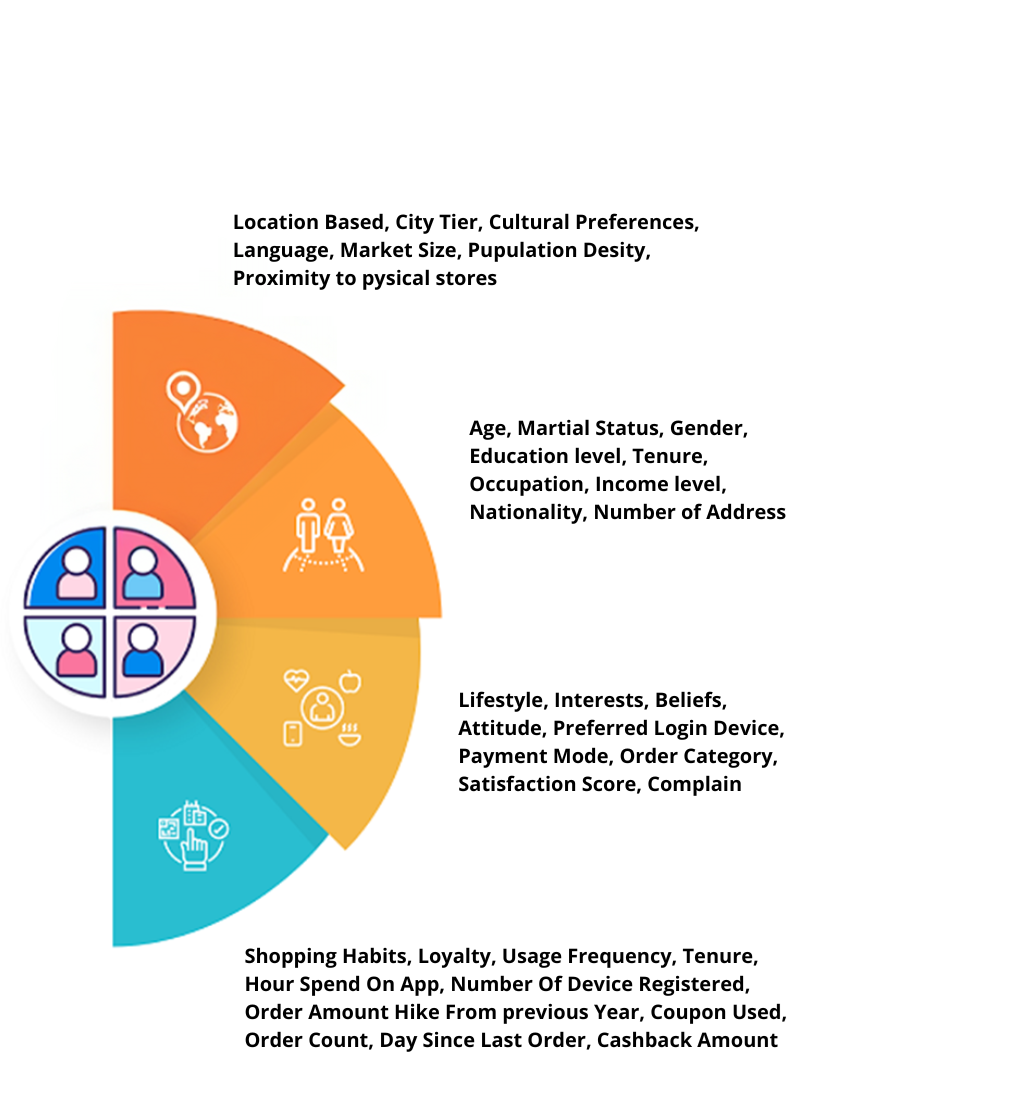
By Dividing a customer base into Groups or segments that share similar characteristics, behaviour, and Interests, Business Can better understand their customer, acquire new customers, retain existing customers, personalize marketing efforts, and tailor product or service to specific customer needs.


    Geographic
    Regional Preference, Market Expansion Opportunities, Localisation Strategies, Seasonal Variations, Delivery & Logistics Optimisation, Cultural Sensitivity, Customer Migration Patterns, CLV Variations


    Demographic
    Targeted Marketing, Product Preferences, Pricing Strategies, Communication Channels, CX Enhancements, Brand image and Loyalty, Social & Cultural Trends, Customer retention


    Psychographic
    Purchase Patterns, Product Usage, Engagement Levels, Customer Journey Mapping, Churn Prediction, Cross-Selling & Upselling, Loyalty program, Campaign Analysis, Customer Feedback Analysis


    Behavioural
    Lifestyle Preferences, Values & Beliefs, Purchase Motivations, Emotional Triggers, CX Enhancement, Communication Styles, Purchase Decision Influences, Product/Service Differentiation


"When the customer comes first, the customer will last." ~ Robert Half


Business Recommendations

Providing accurate and actionable business recommendations is essential for driving growth and improving operational efficiency. Insights enable companies to make informed decisions, optimize resource allocation, and identify new opportunities for innovation and expansion. Implementing data-driven recommendations helps businesses stay competitive, enhance customer satisfaction, and achieve long-term success in a rapidly evolving marketplace.

Quality Icon

Leverage Insights from Loyal Customers
Analyze profiles of loyal customers to identify effective incentives and apply similar strategies to at-risk customers.

Customer Rewards Icon

Offering Incentives to Retain Customers
Offer rewards, discounts, loyalty points to long-term or repeat customers to encourage loyalty. Provide limited time targeted coupons, vouchers, and discounts to high-risk customers, creating a sense of urgency & encourage swift actions.

Delivery Icon

Enhance Delivery and Payment Options
Improve delivery speed and expand payment methods to increase customer satisfaction and reduce churn.

Partnerships Icon

Form Strategic Partnerships
Collaborate with banks and other institutions to offer discounts on credit and debit card purchases, attracting more customers through exclusive offers.

Customer Service Icon

Provide Excellent Customer Service
Ensure prompt and efficient service to resolve customer issues and complaints.

Mobile Experience Icon

Enhance Mobile Experience
Ensure the platform is mobile-friendly and utilize push notifications for effective customer engagement through their mobile devices.

Customer Engagement Icon

Drive Meaningful Customer Communication and Engagement
Regular communication helps build strong relationships and keeps customers engaged. Use email marketing, social media, and push notifications to keep customers informed about products, services, and promotions.

Customer Feedback Icon

Use Customer Feedback to Improve Products and Services
Gather and analyze customer feedback to identify areas for improvement in products and services.

Monitor and Adapt Icon

Continually Monitor and Adapt
Refine churn models and segmentation strategies based on new data, and address customer pain points to improve overall satisfaction.


In the fiercely competitive E-Commerce landscape, substantial investment is needed to acquire new customers, but effective retention is key to sustainable growth. Customer churn prediction is vital for businesses because it enables them to identify at-risk customers before they leave, allowing for proactive retention strategies. Understanding the factors that contribute to churn helps businesses tailor their approaches to individual customer needs and preferences, ultimately enhancing customer satisfaction and loyalty.

By employing machine learning models to predict churn, businesses can allocate resources more effectively, targeting those most likely to leave with personalized incentives and improved services. Churn modeling predicts the likelihood of customer departure, while segmentation directs retention efforts. This dual approach enhances understanding of customer behavior and drives operational improvements. Retention strategies such as enhancing customer support, optimizing product offerings, delivering personalized marketing campaigns, and addressing common pain points are essential. By leveraging data-driven insights from churn prediction models, businesses can not only reduce churn rates but also foster long-term relationships with their customers, leading to sustained growth and competitive advantage.

Insights from these models empower businesses to compete effectively and align their brand positioning. As customer behavior evolves, continuous algorithm refinement based on new data is essential. This integration of churn modeling and customer segmentation equips businesses to improve retention, optimize processes, and stay competitive.